Cosmological Gravitational Redshift
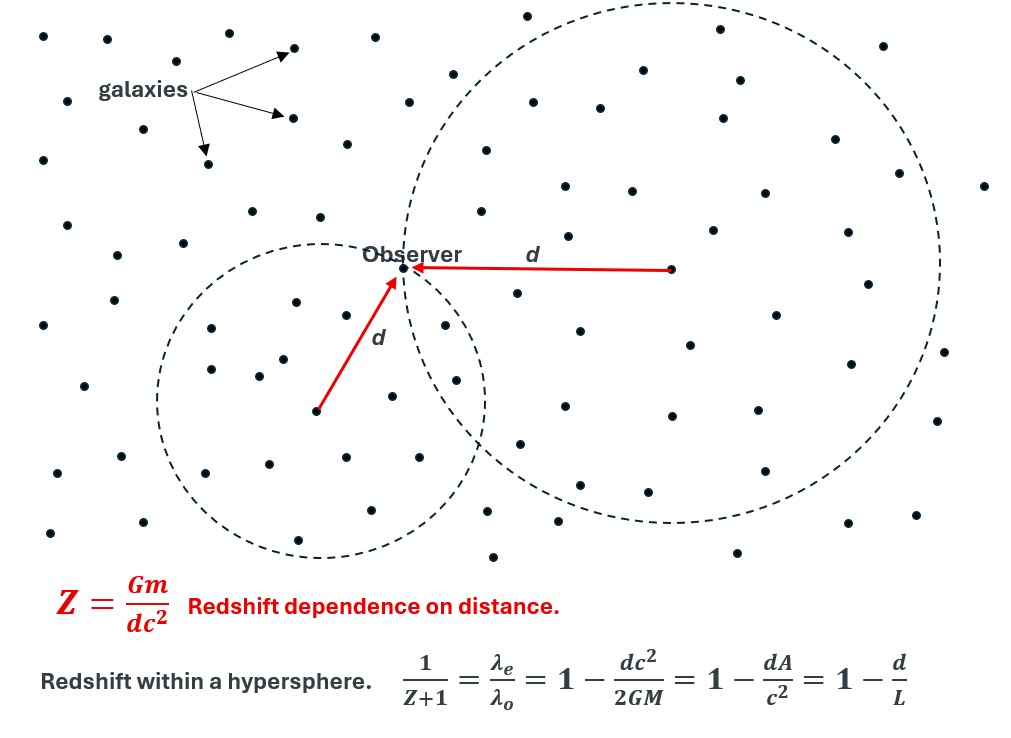
In Hypersphere Cosmology, the redshift of distant galaxies arises from the effect of gravity on light traveling huge distances, rather than from an expansion of the universe as in conventional LCDM Big-Bang Cosmology.
Newton’s Shell Theorem combined with Einstein’s General Relativity indicates that such a Cosmological Gravitational Redshift effect will occur.
Newton’s Shell Theorem demonstrates two things, firstly that a massive spherically symmetric body affects external bodies as though all of its mass acts from its centre point, and secondly that a massive spherically symmetric hollow sphere exerts no net gravitational force on any body inside of it, regardless of that body’s position.
As the universe seems fairly homogenous and isotropic on a large intergalactic scale, we can regard any vast spherical volume of space as both hollow and massive, despite its rather low overall density.
Thus observers should consider themselves located on the surface of a sphere surrounding any distant galaxy they choose to observe and expect to observe a redshift which depends on its distance and all the mass laying within such a sphere.
Thus although observers will not notice a net cosmological gravitational pull from any direction, they will notice that all incoming light from very distant sources becomes redshifted to an extent dictated by the sphere of mass defined by the radius of the distance to those far sources.
This effect should occur in any non-expanding universe, whether hyperspherical or infinite in extent.