
I am very deeply saddened that he departed. I would have very much liked to meet him. It is yet another one of those things that would never occur for they are statistically so unlikely ....Yet, he said that that which was so, was the best grounds to test one's magic. Many good things are going away and what is coming isn't as good. I am his student, and would remain such always.
Hey kids,
Peter was the dude, loving the prog rock, mind racing on ahead, always looking for the hidden trick within the obvious ruse.
We stayed out of each other's hair, mostly, but he was always on my mind.
Show me that horizon, ss
Peter was the dude, loving the prog rock, mind racing on ahead, always looking for the hidden trick within the obvious ruse.
We stayed out of each other's hair, mostly, but he was always on my mind.
Show me that horizon, ss
Dear Peter,
I am a Chaos magician from China. Although Chaos Magic was introduced to China quite some time ago, it has never had a particularly stable audience or widespread recognition here.
Since last year, I have been creating and publishing many videos about Chaos Magic on Bilibili, a Chinese video-sharing platform similar to YouTube. Many of these videos are related to your books and ideas. I believe that, through these efforts, Chaos Magic has become more widely known in China, allowing more new magicians to discover this great and liberating system of magic.
It is deeply regrettable that I never had the chance to contact you before hearing the news of your passing. Nevertheless, I want to express my gratitude for everything you have given us.
I love Chaos Magic.
我爱混沌魔法,感恩您。
I am a Chaos magician from China. Although Chaos Magic was introduced to China quite some time ago, it has never had a particularly stable audience or widespread recognition here.
Since last year, I have been creating and publishing many videos about Chaos Magic on Bilibili, a Chinese video-sharing platform similar to YouTube. Many of these videos are related to your books and ideas. I believe that, through these efforts, Chaos Magic has become more widely known in China, allowing more new magicians to discover this great and liberating system of magic.
It is deeply regrettable that I never had the chance to contact you before hearing the news of your passing. Nevertheless, I want to express my gratitude for everything you have given us.
I love Chaos Magic.
我爱混沌魔法,感恩您。
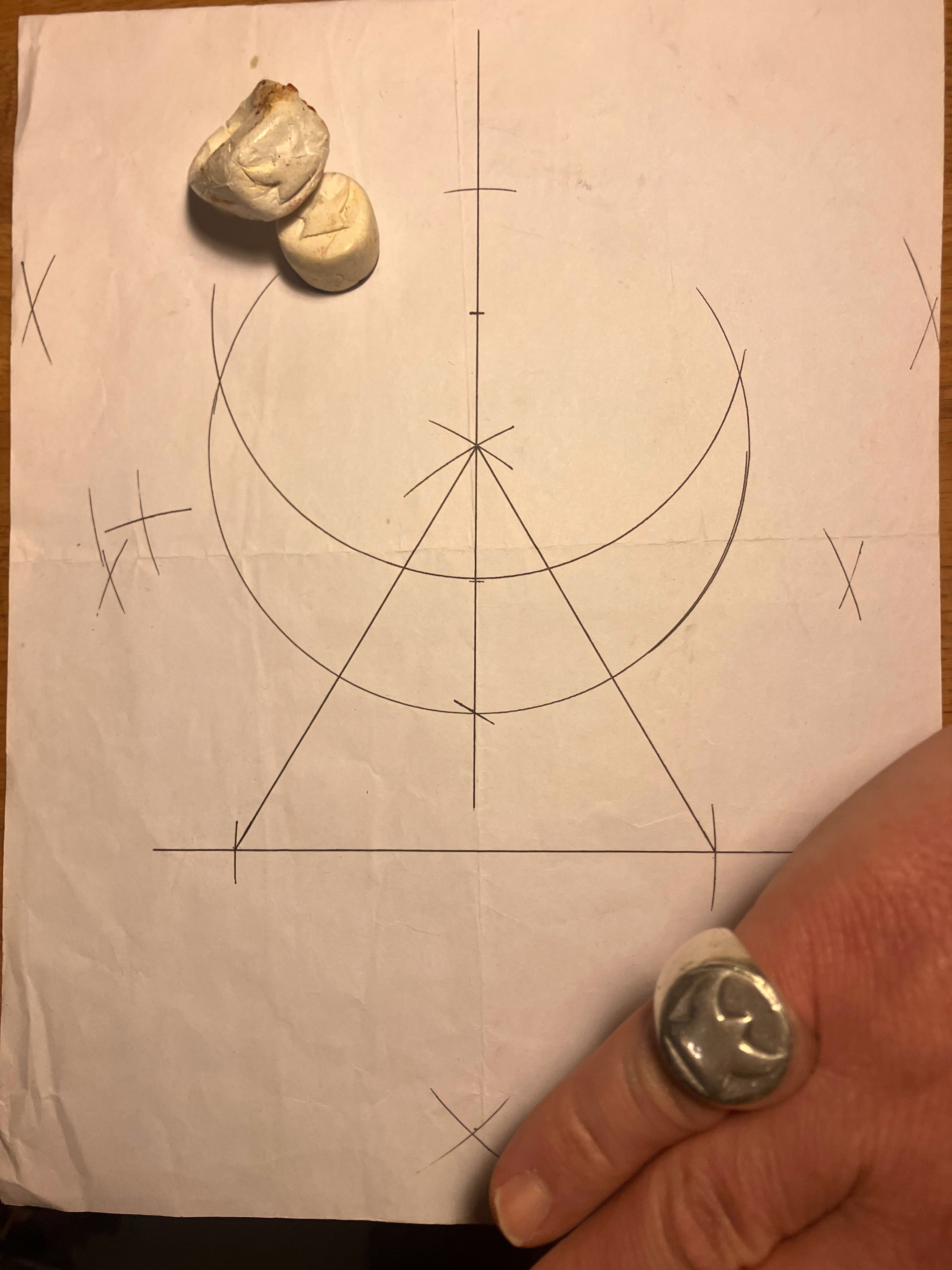
Arcanorium College.
I first met Pete upstairs in his shop in Bristol around 2007. We had a number of superb lunchtime meetings over a couple of years, chewing the magical fat.
During this time we worked on the Arcanorium pin, which then turned into the ring. The drawing on the photo is by Pete’s hand, the ring templates I made from milliput ( he loved that as a material ) and the final ring I had made of silver in Bristol. It has a Chaos star etched on one side and a pentagram on the other.
Thank you Pete for Arcanorium College - RIP.
CHOYOFAQUE!
I first met Pete upstairs in his shop in Bristol around 2007. We had a number of superb lunchtime meetings over a couple of years, chewing the magical fat.
During this time we worked on the Arcanorium pin, which then turned into the ring. The drawing on the photo is by Pete’s hand, the ring templates I made from milliput ( he loved that as a material ) and the final ring I had made of silver in Bristol. It has a Chaos star etched on one side and a pentagram on the other.
Thank you Pete for Arcanorium College - RIP.
CHOYOFAQUE!
The UNCTION has been performed and the master will find his gait. Let the ONE join the 0-1 in the final decree.
Please accept my deepest condolences. I am so sorry for your loss.
I'm sorry to hear, so late, of Pete's passing. Our interactions were few, but always thoughtful...thought provoking. We shared a love of creating magical objects and it was nice to hear him compliment my own and say that he loved seeing the handy works of other wizards. I hope he sees the reality of ALL...maybe he'll even see that the Universe is, in fact, a finite yet boundless, vorticitating hypersphere! Condolences to his family and friends, those who knew and loved him best.
When we talked about wands, and he explained to me that he always used one, and I, being very respectful, said: 'Master Carroll...', he replied: 'Call me Pete.'
I felt it whenever I opened his emails; he reminded me of a father—the scolding kind... because I would mess up when it came to magic. When we talked about the wand and how he used one made of mango wood... I felt a silence, and then the scolding.
I’m going to miss him.
My greatest experience with Pete was learning how to get things done. How to eliminate the noise of arguments and validations—whether I recognize your lodge, your school, your lineage. In four words, "let's get to work." Pete, we miss you.
I felt it whenever I opened his emails; he reminded me of a father—the scolding kind... because I would mess up when it came to magic. When we talked about the wand and how he used one made of mango wood... I felt a silence, and then the scolding.
I’m going to miss him.
My greatest experience with Pete was learning how to get things done. How to eliminate the noise of arguments and validations—whether I recognize your lodge, your school, your lineage. In four words, "let's get to work." Pete, we miss you.
I will leave it to others better qualified to speak of Pete’s seminal work in the field of occult thought and practice. Instead, I would like to offer a more personal story.
During the year that Ray and Len Sherwin spent in Egypt, Pete was living in their house at East Morton, a house I was later to live in myself. I would sometimes visit and enjoyed walks and conversation with him. We also performed rituals, with others, on Rombald’s Moor, sometimes at the Twelve Apostles stone circle, that did not end until the day’s light was growing in the east. I cannot now remember who those others were.
He would sometimes regale me with tales of his travels. One such stands out; once aboard a ship in the Indian Ocean and heading for some port in India, a terrible storm arose, which increased in intensity to such a degree that all aboard thought they would surely perish. On board were Christians, Muslims, Sikhs and Hindus who soon were all calling upon their several gods for deliverance. “It got so bad,” said Pete dryly, “that even I cast the odd conjuration upon the waves.”
The storm eventually abated and they made into port. The local yacht club had heard a ship was arriving with English people on board and were waiting to greet them on the quay. The yachtsmen were all smartly dressed in their blazers, cravats and peaked caps. They were not a little taken aback by the motley crew of hippies and bohemians they had turned out to meet!
Pete once told me that he had no understanding of the word ‘spirit’, other than in the sense of ‘esprit de corps’; he certainly was a spirited individual, possessing vitality and vigour in thought, word and deed.
I don’t know what Pete’s thoughts were on life after death. I personally do not believe that death is the end. I will finish with a poem I wrote on death as a final initiation, transformation and liberation.
“The End is Nigh!” … all lowered in the grave,
The leveller spares not the highest caste.
A waste of energy to be afraid.
Live every day as if it were the last,
So some will say, you died not blindly drinking,
No, not in idle pleasures, food and song,
But seeking mysteries, controlling thinking;
Not humming others’ tunes but writing one!
And what of life beyond? To hell with what
The preacher says, and anyway we’d find
Much better company among the damned.
Free spirits won’t live in the grave’s small plot.
Finally disembodied; soul and mind,
A formless force, a power to expand.
During the year that Ray and Len Sherwin spent in Egypt, Pete was living in their house at East Morton, a house I was later to live in myself. I would sometimes visit and enjoyed walks and conversation with him. We also performed rituals, with others, on Rombald’s Moor, sometimes at the Twelve Apostles stone circle, that did not end until the day’s light was growing in the east. I cannot now remember who those others were.
He would sometimes regale me with tales of his travels. One such stands out; once aboard a ship in the Indian Ocean and heading for some port in India, a terrible storm arose, which increased in intensity to such a degree that all aboard thought they would surely perish. On board were Christians, Muslims, Sikhs and Hindus who soon were all calling upon their several gods for deliverance. “It got so bad,” said Pete dryly, “that even I cast the odd conjuration upon the waves.”
The storm eventually abated and they made into port. The local yacht club had heard a ship was arriving with English people on board and were waiting to greet them on the quay. The yachtsmen were all smartly dressed in their blazers, cravats and peaked caps. They were not a little taken aback by the motley crew of hippies and bohemians they had turned out to meet!
Pete once told me that he had no understanding of the word ‘spirit’, other than in the sense of ‘esprit de corps’; he certainly was a spirited individual, possessing vitality and vigour in thought, word and deed.
I don’t know what Pete’s thoughts were on life after death. I personally do not believe that death is the end. I will finish with a poem I wrote on death as a final initiation, transformation and liberation.
“The End is Nigh!” … all lowered in the grave,
The leveller spares not the highest caste.
A waste of energy to be afraid.
Live every day as if it were the last,
So some will say, you died not blindly drinking,
No, not in idle pleasures, food and song,
But seeking mysteries, controlling thinking;
Not humming others’ tunes but writing one!
And what of life beyond? To hell with what
The preacher says, and anyway we’d find
Much better company among the damned.
Free spirits won’t live in the grave’s small plot.
Finally disembodied; soul and mind,
A formless force, a power to expand.
What kind of a powerful mage, who while being known so far and wide, and being so well regarded, could manage to keep photographs of his face away from the mighty internet? Even the pictures one found of him, weren't even him! One of his many great feats on this earth.
Goodbye Chancellor
Goodbye Chancellor
Like many others, I was deeply influenced by Liber Null & Psychonaut. But Pete’s later works, especially Epoch: Esotericon & Portals of Chaos, also left a strong impression on me. His willingness to continue experimenting, questioning, and updating his ideas until the very end was truly inspiring.
Thank you for everything, Pete.
— Le Sorcier Inconnu
Thank you for everything, Pete.
— Le Sorcier Inconnu
I recently typed up some words for the late John "OZZY" Osbourne on the City of Birmingham website months ago. I expressed something along the lines of not having much direction as a kid--dysfunctional parents--and Ozzy's music being a guide through difficult emotions. Peter Carroll's magic was a guide for me as a young adult navigating limited resources and economic hardship. The teachings of Liberation, Probability Manipulation, and Sigils provided me with magic in order to beat the odds that were stacked against me. I'm not a member any magical order--only a community college educated blue collar worker from the rust belt of the USA, Carroll's death reminds me of how much closer I am to my own death. I must make the remaining time an adventure.
Kenosha, Wisconsin USA
Kenosha, Wisconsin USA
Pete's work, which I first encountered in the mid to late 90s, opened my mind to ideas that changed my approach to, well, everything I've done since. Later, it was my honor and a privilege to be a student of his at Arcanorium College.
Thank you, Pete, for an experience I will cherish always.
Safe travels, Chancellor.
Thank you, Pete, for an experience I will cherish always.
Safe travels, Chancellor.
I had only just begun speaking with Peter several months before he passed. When I first encountered his work in 2025, I felt I had finally found the magical current I’d been seeking for ten years. It was through Discordianism that I eventually discovered Chaos Magic. After reading Liber Null and Psychonaut, I knew I had to contact the modern day magus behind these works.
Carroll was funny, wise, and endlessly curious. He understood (as I think everyone does, deep deep down) that magic is not only real, it is a vital part of our reality. I have a feeling that in the coming years, his work will be hailed as prophetic. Strange Aeons ahead…
I only wish I could have learned more from him, and had the chance to meet him in person. Perhaps in the Ether.
RIP The Wizard
Carroll was funny, wise, and endlessly curious. He understood (as I think everyone does, deep deep down) that magic is not only real, it is a vital part of our reality. I have a feeling that in the coming years, his work will be hailed as prophetic. Strange Aeons ahead…
I only wish I could have learned more from him, and had the chance to meet him in person. Perhaps in the Ether.
RIP The Wizard
The Chancellor was one of the few modern scientist-sorcerers. The world got a huge gap with his departure. His ideas on speculative (rebellious) physics are the fruits of geniality and courage. Magic and science are two regions of the same spectrum, in his view. I met Pete's books on two occasions: as the foundations and the most relevant developments of a cutting-edge magical practice (chaos magic), but also as a deep and honest conciliation between magic (theory and practice), reason, and science. His essay "The Magician as Rebel Physicist" had and still has a big impact on my life as a physicist and a magician. I was extremely fortunate to be his student at the Arcanorium College, and I will hold an eternal gratitude.
I did not Peter personally. I know his work intimately, across multiple texts, and I know it the way you know the mind of someone who has been a genuine interlocutor over years of reading, even in the absence of any direct exchange. He argued with me, through his books, many times. He usually won. He dominated my mind, and expanded my consciousness in many strange and novel directions.
He spent his life asking the most rigorous possible version of the question that magic had always asked, and he never stopped updating his answer when the evidence required it. He moved from Liber Null's stripped minimalism through Liber Kaos's systematic development through The Octavo's attempt to marry magical and physical theory through the anthology work of This Is Chaos, always in the direction of greater precision, greater intellectual honesty, greater willingness to be wrong and say so.
The tradition he helped found is a method. Its survival requires continuation, which means practitioners willing to do what Carroll did: take the best available understanding of reality seriously, apply it to the actual practice, record results honestly, and update accordingly. The best available understanding of reality in 2026 includes distributed machine intelligence, networked egregores at scale, digital environments that reshape consciousness whether or not consciousness is brought to them deliberately, and the specific strangeness of AI systems that produce outputs that cannot be fully predicted from their inputs.
Carroll knew that magic which refuses to engage with its moment becomes a relic. He refused to become a relic. The Octavo, published in 2011, was an attempt to ground magical theory in contemporary physics that most of his readers found demanding and some found eccentric. He did not soften it. He published it because it was where the thinking had gone, and he trusted the tradition to follow him there.
Thanks for everything, Pete. Wish we could have shared a drink one day.
He spent his life asking the most rigorous possible version of the question that magic had always asked, and he never stopped updating his answer when the evidence required it. He moved from Liber Null's stripped minimalism through Liber Kaos's systematic development through The Octavo's attempt to marry magical and physical theory through the anthology work of This Is Chaos, always in the direction of greater precision, greater intellectual honesty, greater willingness to be wrong and say so.
The tradition he helped found is a method. Its survival requires continuation, which means practitioners willing to do what Carroll did: take the best available understanding of reality seriously, apply it to the actual practice, record results honestly, and update accordingly. The best available understanding of reality in 2026 includes distributed machine intelligence, networked egregores at scale, digital environments that reshape consciousness whether or not consciousness is brought to them deliberately, and the specific strangeness of AI systems that produce outputs that cannot be fully predicted from their inputs.
Carroll knew that magic which refuses to engage with its moment becomes a relic. He refused to become a relic. The Octavo, published in 2011, was an attempt to ground magical theory in contemporary physics that most of his readers found demanding and some found eccentric. He did not soften it. He published it because it was where the thinking had gone, and he trusted the tradition to follow him there.
Thanks for everything, Pete. Wish we could have shared a drink one day.
Although I only spoke directly with Pete a few times through email, he was incredibly open and encouraging toward younger people like me in these spaces. He was always willing to discuss, share, and engage without gatekeeping.
As someone who fuses the occult into my fashion work, Pete inspired me deeply to experiment with different magical tools and systems of belief. That experimentation inspired me to pursue material exploration within my fashion designs with the same mindset. I began disregarding what certain materials were traditionally used for and pushing the limits of their use cases in search of newness through their application. At the same time, during those long periods of spiritual immersion and experimentation, I began building my own magick toolbox, which eventually translated into crafting my own design language.
Pete started a revolution through his work, and I believe it is up to those of us who are often the youngest in these occult spaces to continue passing his spirit of experimentation forward to future generations of chaos magicians.
RIP Pete
As someone who fuses the occult into my fashion work, Pete inspired me deeply to experiment with different magical tools and systems of belief. That experimentation inspired me to pursue material exploration within my fashion designs with the same mindset. I began disregarding what certain materials were traditionally used for and pushing the limits of their use cases in search of newness through their application. At the same time, during those long periods of spiritual immersion and experimentation, I began building my own magick toolbox, which eventually translated into crafting my own design language.
Pete started a revolution through his work, and I believe it is up to those of us who are often the youngest in these occult spaces to continue passing his spirit of experimentation forward to future generations of chaos magicians.
RIP Pete
I started my magickal journey voraciously reading Liber Null & Psychonaut and Liber Kaos, and they revolutionized my mode of thinking and created the practitioner I am today. I want to thank Mr. Carroll for his massive contribution to occult literature, and today I wear the eightfold arrow in his honor--in addition to being a symbol of my path.
Peter J. Carroll, a cross-disciplinary thinker and avant-garde researcher, or, as he more accurately defined himself, a natural philosopher, grounded magical thought in contemporaneity and paved the way for a methodology that takes into account the most advanced tools of science and philosophy. He created a theory and a praxis capable of reconfiguring any culture and phenomenology, traversing them without being bound by them.
For the young person I once was, immersed in radical critique and imbued with an iconoclastic spirit, reading him was a revelation, a luminous flash that has never faded, interlocking fluidly and infusing a freedom never superficial into the Parliament of my reflections. And there that light has remained. A light that we can now all see shining in the words and in the operative dimension even of those who are not aware of its cultural re-founding.
He leaves an indispensable theoretical corpus, an ineludible reference, and a fertile inspiration for the free creative researcher. Having engaged with his system was a fortune; having had the opportunity to interact with Stokastikos was a rare privilege. I will never forget his generous attention and his cultivated assertiveness, both sympathetic and caring. I will miss him, and I already do, even as he remains so influential and present at the roots of magical practices, now infused with the depth of his thought.
With deep gratitude toward Stokastikos and with affection for all those connected to him.
For the young person I once was, immersed in radical critique and imbued with an iconoclastic spirit, reading him was a revelation, a luminous flash that has never faded, interlocking fluidly and infusing a freedom never superficial into the Parliament of my reflections. And there that light has remained. A light that we can now all see shining in the words and in the operative dimension even of those who are not aware of its cultural re-founding.
He leaves an indispensable theoretical corpus, an ineludible reference, and a fertile inspiration for the free creative researcher. Having engaged with his system was a fortune; having had the opportunity to interact with Stokastikos was a rare privilege. I will never forget his generous attention and his cultivated assertiveness, both sympathetic and caring. I will miss him, and I already do, even as he remains so influential and present at the roots of magical practices, now infused with the depth of his thought.
With deep gratitude toward Stokastikos and with affection for all those connected to him.

Dear Pete,
You were always there for me, answering my questions about magick no matter the time or the complexity. I remain deeply grateful for the guidance you provided and for the "homework" you assigned me. To receive such tasks from a teacher of your stature was, and still is, a profound honor that I cherish. You were, in every sense, a wonderful teacher.
The fact that you contributed to my books twice to guide the Japanese people is a peerless treasure for all those in Japan who study your philosophy. Furthermore, the answers you provided in numerous interviews will surely become a legacy for the entire world.
I have composed this music with all my tenderness and love for you. I hope that everyone who hears it will feel your greatness and the warmth of your spirit.
You were the greatest magus of the 21st century. Beyond that, you were a teacher who was kind, warm, and full of love. I vow to carry forward at least a part of your legacy and will.
To my teacher: I offer you my deepest gratitude and my utmost love.
On behalf of Japan,
SENSEI ARIGATOUGOZAIMASHITA
You were always there for me, answering my questions about magick no matter the time or the complexity. I remain deeply grateful for the guidance you provided and for the "homework" you assigned me. To receive such tasks from a teacher of your stature was, and still is, a profound honor that I cherish. You were, in every sense, a wonderful teacher.
The fact that you contributed to my books twice to guide the Japanese people is a peerless treasure for all those in Japan who study your philosophy. Furthermore, the answers you provided in numerous interviews will surely become a legacy for the entire world.
I have composed this music with all my tenderness and love for you. I hope that everyone who hears it will feel your greatness and the warmth of your spirit.
You were the greatest magus of the 21st century. Beyond that, you were a teacher who was kind, warm, and full of love. I vow to carry forward at least a part of your legacy and will.
To my teacher: I offer you my deepest gratitude and my utmost love.
On behalf of Japan,
SENSEI ARIGATOUGOZAIMASHITA